
| |
 COMPANY COMPANY |
| |
|
Words
of SWOT
Words
can be art.
Life is a balancing act.
Alter your life by altering
your attitudes.
Take charge of your own destiny.
Every coin
has two sides.
Understand your strengths and weaknesses.
Clearly
assess your strengths and weaknesses.
Concentrate on your strengths instead
of dwelling on your weaknesses.
Do not misuse your strengths.
Strength comes from commitment.
The more things you plan to do, the more
energy you will have.
The higher you go, the better the view.
People take advantage of your weaknesses.
If you reveal a weakness, it
can become a strength.
Organize your day in the morning.
Seize
every opportunity.
Opportunities are made not found.
Take advantage
of the opportunities that are presented to you.
Change brings new opportunity.
Small changes add up to a big change.
The fear of change is usually
far worse than the actual change.
The past is the only part of your life
that you cannot change.
Most viewpoints should change with time.
Everything is the result of change.
Mistakes are opportunities to
learn.
When opportunity knocks, open the door.
If you do not
take advantage of an opportunity, then someone else will.
Good products
are worth more than they cost.
Everything has its price.
Higher
price doesn't necessarily mean higher quality.
Cheap goods always prove
expensive.
Do not burn your bridge after you cross.
Don't burn
your bridges behind you.
Do not bite the hand that feeds you.
Don't throw away the old bucket until you're sure the new one holds water. |
|

|
 |
We are proudly reconfirmed and reinforced by our outstanding products, Factories, services, partners and potential customers (click here) . Please see everything shown in this website. Thank you ! |
 |
POYANG
SWOT Analysis
| Strengths potentially positive internal factors | Weaknesses potentially negative internal factors |
| 1.
| Strong
team, very knowledgeable & flexible. | | 2.
| Multiple
products & sources available. | | 3.
| Customer
& service oriented. Always can offer very competitive & innovative products. |
| 4.
| Well
experienced and with very good reputation. |
| 5. | Speedy
& instant in reaction. | | 6. | Easy
to communicate & abundant in e-information. |
|
| 1.
| In
people service business, but limited to get enough capable people. |
| 2.
| Business
is up-and-down with customers. | | 3.
| Not
so good to play political game with some customers & suppliers. |
| 4. | Need
more global sourcing & local touch. | |
| Opportunities: potentially positive external factors |
Threats: potentially negative external factors |
| 1.
| Old
customers always introduce new business & new customers. |
| 2.
| Grow
together with existing customers. | | 3.
| More
and more strong supports from many suppliers in Taiwan & China. |
|
| 1.
| Very
keen competition. | | 2.
| Greatly
affected by customer changes. | | 3.
| Must
follow business cycle & market shift. | |
A
SWOT analysis is a method for describing your business (or your business proposition)
in terms of those factors that have the most impact. Essentially
you nominate the Strengths and Weaknesses of
the business (its internal resources and capabilities), then you identify the
Opportunities and Threats it faces (factors
external to the organisation). This
is an easy, understandable way of identifying key issues and communicating them
to others. And to make things even simpler to grasp, the typical SWOT analysis
is done on a four-cell grid: 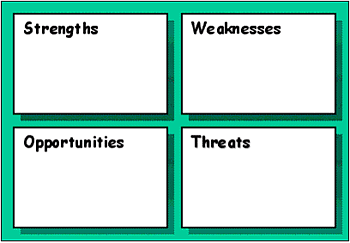
| How
To Perform a Swot Analysis |  |
A SWOT Analysis is an integral part of a marketing plan and can also be part of
a business plan. Knowing what a SWOT Analysis is and how to perform one is very
important. | What
is a SWOT Analysis?
A SWOT analysis stands for Strengths, Weaknesses,
Opportunities, and Threats and is a simple and powerful way to analyze your company's
present marketing situation. |  http://www.poyang-intl.com.tw http://www.poyang-intl.com.tw |
| |